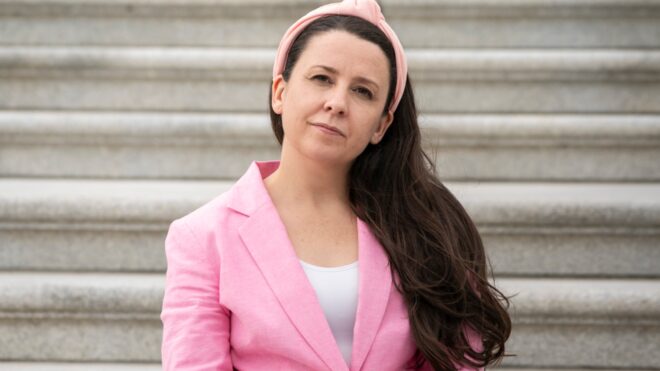
While the stats remain sobering — only 6% of CEOs in the top 3,000 US companies are women; the raw number, 167, is still double what it was 10 years ago — the women who are in charge are here to inspire the next generation.
Anne Wojcicki
Lisa Price
Founder, Carol's Daughter
In 1993, Lisa Price began making essential oil-based natural hair and beauty products in her Brooklyn, New York, kitchen. When she sold her company to L'Oréal in 2014, it was worth $27 million. Price said, of being the only woman of color at the table many times throughout her career, “It’s about knowing that there are preconceived ideas that people will have when you walk in the room, and not focusing on them,” she told NBC News. “You focus on your business, you focus on your numbers. Numbers always speak louder than any prejudice. … Whatever bias someone has, you have no control over it.”
Shiza Shahid
Former CEO, Malala Fund
Shiza Shahid made her name in her 20s as the right hand to Malala Yousafzai and founding CEO of the Malala Fund, which was created to empower girls through advocacy, storytelling, and entrepreneurship. The Pakistani social entrepreneur, who went on to found Now Ventures, a seed fund for mission-driven startups, Shahid most recently co-founded Our Place, a line of cookware “for the modern, multiethnic American kitchen.” Our Place is also driven by a socially conscious ethos. “We’ve been trying very hard to invest in women in all that we do,” she told Life & Thyme. “That’s a choice that everyone can make. If you’re working in a company, you can look harder to find a candidate who is a woman or a person of color or an immigrant and give them the mentorship that will allow them to succeed.”
Elaine Welteroth
Former editor-in-chief, Teen Vogue
When Elaine Welteroth became editor-in-chief of Teen Vogue in 2017, she was, at 29, the youngest person and only the second person of color to helm any of Conde Nast’s big-name magazines. (Welteroth had also been the magazine’s first black beauty director.) “I didn’t walk to the table with my fist up,” Welteroth told The Guardian. “I was a 25-year-old black woman who worked hard to get a dream job, then found out in the headlines that in fact I had become a black woman making history.” By the time Welteroth left Teen Vogue in 2018, she had given the fashion magazine a socially conscious makeover, earning it headlines like, "The True Story of How Teen Vogue Got Mad, Got Woke, and Began Terrifying Men Like Donald Trump."
Sarah Miyazawa LaFleur
Co-founder and CEO, M.M.LaFleur
Sarah LaFleur co-founded M.M.LaFleur, a direct-to-consumer clothing brand for working women, in 2011, because she hated getting dressed in the morning for her corporate job. “We tend to think of being unhappy as a negative thing,” LaFleur told The Cut. “But there’s a lot of good that can come out of listening to why you’re so unhappy. It’s important to remember that your career actually spans 40, sometimes 50, years. The little changes that you make at a certain point in your career are really a blip on the radar, and not this life-changing moment.”
Jennifer Hyman
Co-founder and CEO, Rent the Runway
Jennifer Hyman co-founded Rent the Runway in 2009 — and in 2018, at nine months pregnant, became one of fewer than 20 women to run a private US company valued at more than $1 billion. But she does not take her achievements for granted. “Most people don't get to choose what type of job that they want,” Hyman told Forbes. “I think that a lot of the power that I have now is because of the luck that I had in terms of where I was born and the family that I was born into, and I never forget that. I don't think that I'm here because I'm smarter or I'm more capable [than] other people. I think I've been given a lot more chances.”
Sara Blakely
Founder, Spanx
In 1998, with just $5,000 in capital, a 27-year-old Sara Blakely launched the shapewear brand Spanx — which is now a household name akin to Kleenex. Blakely was named the youngest self-made female billionaire by Forbes in 2012, and has continued to support women in business. In April 2020, she pledged $5,000 to 1,000 female entrepreneurs hurt by the coronavirus pandemic, for a total of $5 million. “I know first hand what it’s like to be a small-business owner,” she told Fortune. “As a woman, it can be lonely and scary, especially during a time like this. Small business is the backbone of our culture, and I want to help.”